
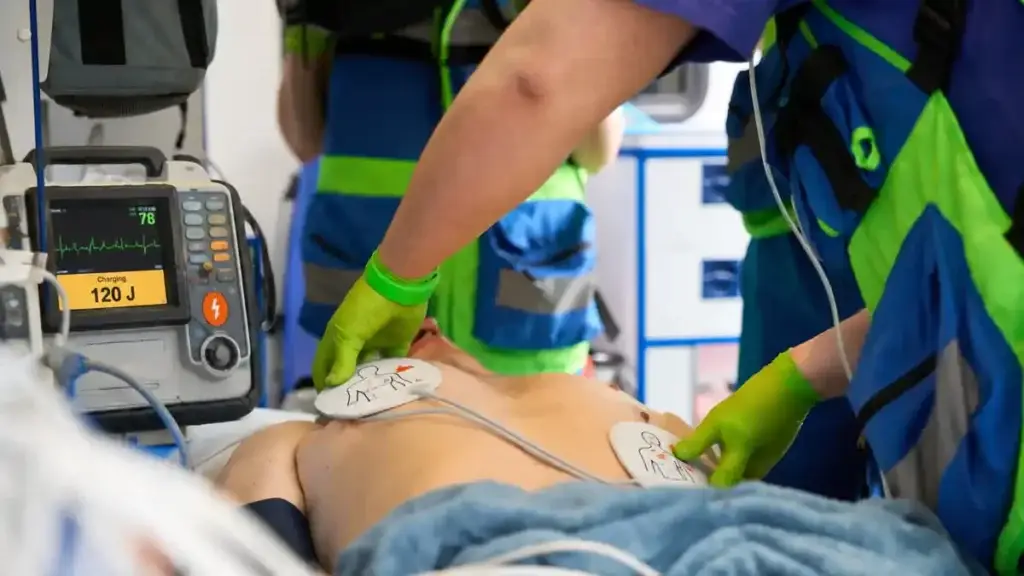
Quick answer: refractory VF is ventricular fibrillation that continues after three consecutive shocks. Under the Resuscitation Council UK (RCUK) 2025 guidelines, you continue high-quality CPR, give adrenaline 1 mg and amiodarone 300 mg after the third shock, check pad position and contact, consider increasing the shock energy if your defibrillator allows, and consider a vector change to an antero-posterior pad position. Double sequential external defibrillation (DSED) improved outcomes in one trial, but RCUK does not recommend its routine use.
Refractory VF is a favourite MRCEM topic because it tests ALS algorithm knowledge, recent trial evidence and the difference between what is “evidence-based” and what UK guidelines recommend. This article covers what you need for the exam. It follows the RCUK 2025 Adult Advanced Life Support guidelines, published on 27 October 2025.
What is refractory VF?
RCUK defines refractory VF as continuous VF after three consecutive shocks. It is different from recurrent VF, where shocks terminate VF but it keeps coming back. The distinction matters, because the causes and treatments overlap but are not identical.
Common reasons VF does not respond to standard shocks include:
- Ongoing myocardial ischaemia, such as an occluded coronary artery.
- High transthoracic impedance, from poor pad contact, a hairy chest or a large body habitus.
- Poor shock vector, where current from antero-lateral pads does not pass through enough of the myocardium.
- Reversible causes that have not been treated: the 4 Hs and 4 Ts, such as hyperkalaemia, hypothermia, tension pneumothorax or toxins.
The RCUK 2025 approach, step by step
| Step | What to do |
|---|---|
| Throughout | High-quality chest compressions with minimal interruptions, effective ventilation and correct pad placement |
| After the 3rd shock | Adrenaline 1 mg IV/IO and amiodarone 300 mg IV/IO |
| Ongoing | Adrenaline 1 mg every 3–5 minutes (alternate loops) |
| After the 5th shock | Amiodarone 150 mg IV/IO |
| If amiodarone is not available | Lidocaine 100 mg IV, with a further 50 mg after five shocks |
| Energy | If the first shock fails and the defibrillator can deliver higher energy, it is reasonable to increase the energy for later shocks |
| Refractory VF | Consider a vector change, using an alternative pad position such as antero-posterior |
| All the way through | Look for and treat reversible causes (4 Hs and 4 Ts) |
Antero-lateral remains the default position for the first pads. The vector change is a step for VF that has not responded.
Vector change and DSED: what the evidence shows
The DOSE-VF trial (Cheskes et al., New England Journal of Medicine, 2022) studied adults with out-of-hospital refractory VF. It compared three strategies:
- Standard defibrillation with antero-lateral pads.
- Vector change (VC): moving the pads to an antero-posterior position.
- Double sequential external defibrillation (DSED): two defibrillators with two sets of pads (antero-lateral and antero-posterior), fired in rapid sequence by a single operator.
Both VC and DSED were associated with higher survival to hospital discharge than standard defibrillation, with the largest effect for DSED. The trial was relatively small and stopped early, which limits how certain we can be.
How the guidelines interpret it
- ILCOR: suggests that DSED (weak recommendation, low certainty of evidence) or vector change (weak recommendation, very low certainty) may be considered for adults who remain in VF/pVT after three or more shocks.
- RCUK 2025: recommends considering a vector change, but does not recommend the routine use of DSED, citing practical challenges and limited evidence of efficacy.
Exam tip: if a UK-based question asks for the next step in refractory VF after three shocks, with good-quality CPR and drugs already given, a vector change to antero-posterior pads is the answer most closely aligned with RCUK guidance. Read the options carefully, as some questions are written around the DOSE-VF evidence.
Other options in refractory VF
- Mechanical CPR: can help maintain high-quality compressions during prolonged resuscitation or transfer.
- Extracorporeal CPR (ECPR): RCUK says ECPR may be considered as a rescue therapy for selected patients in specialist centres when conventional CPR is failing.
- Coronary angiography: refractory VF is often caused by acute coronary occlusion, so early discussion with cardiology matters in the right patient.
Common exam traps
- Magnesium: for torsades de pointes or hypomagnesaemia, not for routine refractory VF.
- Stopping resuscitation early: shockable rhythms have the best chance of a good outcome, so refractory VF alone is not a reason to stop.
- Adding lidocaine on top of amiodarone: lidocaine is the alternative when amiodarone is unavailable, not an add-on.
- Two defibrillators through one machine: DSED uses two separate defibrillators. Never connect two sets of pads to one device.
Summary
- Refractory VF is continuous VF after three consecutive shocks.
- Adrenaline 1 mg and amiodarone 300 mg after the 3rd shock, amiodarone 150 mg after the 5th.
- Check pad contact, consider higher energy and consider a vector change to antero-posterior pads.
- DOSE-VF showed benefit for VC and DSED, but RCUK 2025 does not recommend routine DSED.
- Always look for reversible causes and consider ECPR in specialist centres.
Frequently asked questions
How many shocks before VF is called refractory?
RCUK defines refractory VF as continuous VF after three consecutive shocks.
Does the Resuscitation Council UK recommend DSED?
No. The 2025 guidelines do not recommend its routine use, but they do recommend considering a vector change, such as antero-posterior pads.
When is amiodarone given in VF?
300 mg IV after a total of three shocks, and a further 150 mg after a total of five shocks.
What did the DOSE-VF trial show?
In out-of-hospital refractory VF, both vector change and DSED were associated with better survival to hospital discharge than standard defibrillation.
Next steps
Test yourself on this topic: our 20 free MRCEM SBA sample questions include a refractory VF scenario. For more, explore our Resuscitation course, or see the full question bank, mock tests and mind maps in our membership plans.
Clinical content checked against the Resuscitation Council UK 2025 Adult ALS guidelines and the ILCOR recommendations on 1 October 2026. This article is for exam preparation. Always follow current national and local guidance in clinical practice.